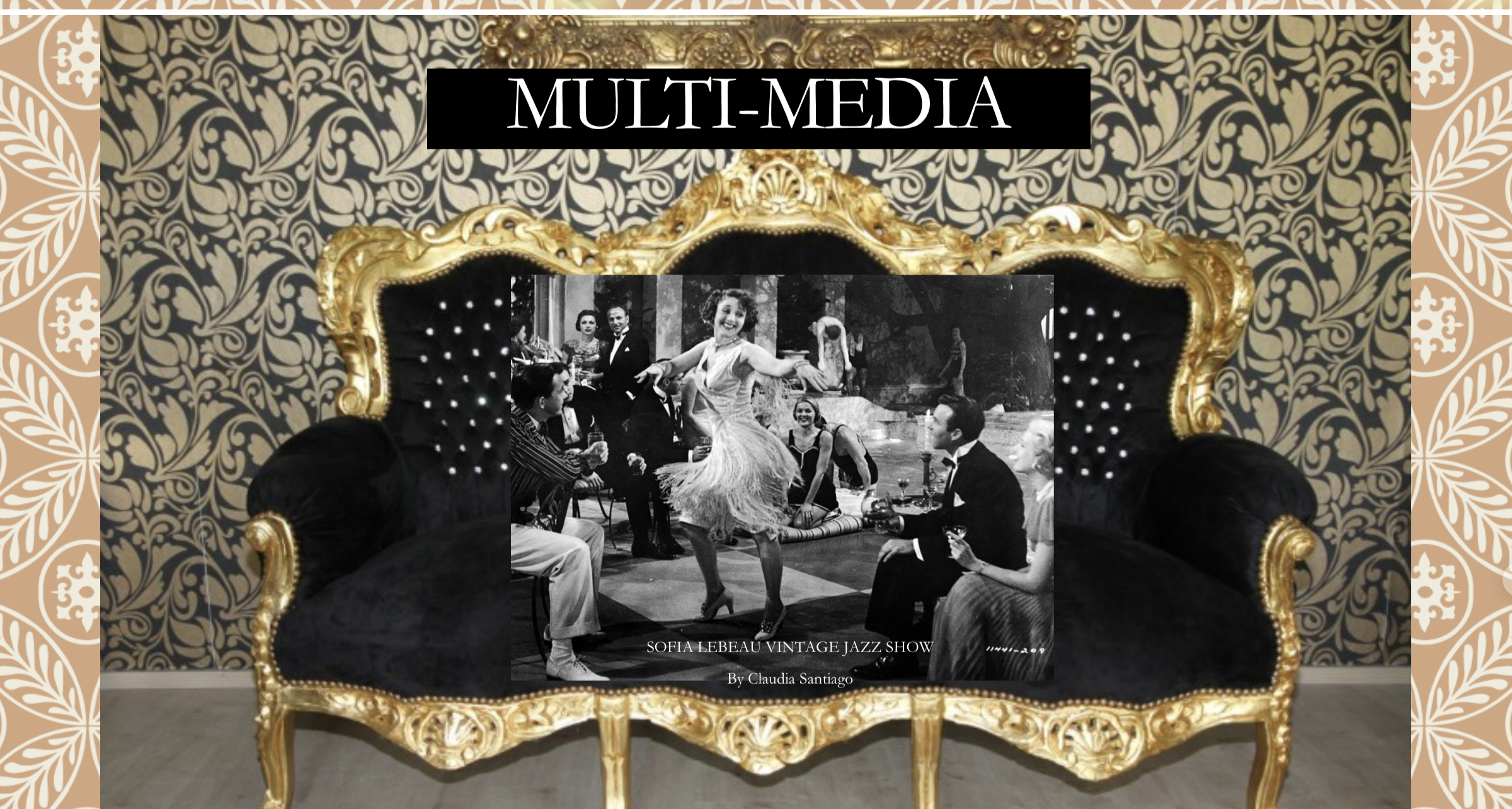
“Sofia LeBeau Vintage Jazz Show”
by Claudia Santiago
Promo Video

Thank you to all our wonderful audiences that enjoy this genre and attend shows enthusiastically. Thank you to the amazing musicians involved in our projects, dancers, the venues, those involved in costuming, stage support, sound, lighting and behind the scenes supporters. Also a special thank you to Scott Sproxton of Simply Early Jazz for the Vintage Jazz arrangements! Please visit our bookings page for a public booking or private and corporate. Please book ahead of time for holiday seasons!
“All of Me”
1931
Writers: Gerald Marks and Seymour Simons
Early Performers:
1931 Belle Baker (radio) | 1931 Mildred Bailey with Paul Whiteman Orchestra
1932 Louis Armstrong – Ben Selvin | 1932 Film “Careless Lady”
1941 Billie Holiday | 1943 Lynne Sherman & Count Basie Orchestra
Gerald Marks and Seymour Simons wrote the words and music of “All of Me” in 1931. It has an ABAC structure, and is written in the key of B-flat major. There is a 20-bar introductory verse, but this is routinely omitted.
“The melody combines the contradictory possibilities of the song. The downward thrusts of the opening phrases hint at emotional despair while the closing line, with its repeated high notes, seems almost jubilant.” It is usually performed at a medium tempo. The harmony is relatively straightforward, and has served as the basis for Lennie Tristano’s “Line Up”, Warne Marsh’s “Background Music”, and Bill Dobbins’s “Lo Flame”.
“All of Me” first came to public awareness when a performance by Belle Baker was broadcast over the radio in 1931. Paul Whiteman and His Orchestra recorded the song on December 1 that year, with vocalist Mildred Bailey; this went to the top of the US pop charts.[1] Within weeks, another two versions were in the charts, with a Louis Armstrong rendition also reaching No. 1, and Ben Selvin and His Orchestra peaking at No. 19. The song was used in the 1932 film Careless Lady. In the view of critic Ted Gioia, the definitive version was sung by Billie Holiday in 1941: “she staked a claim of ownership that no one has managed to dislodge in subsequent years”. Two years later, Lynne Sherman’s recording with Count Basie and His Orchestra reached No. 14 in the charts.
Frank Sinatra recorded several versions of “All of Me”. His 1948 release peaked at No. 21. He also sang it in the film Meet Danny Wilson, which may have helped Johnnie Ray’s rendition up to No. 12 in the charts that year. Sinatra’s use of “All of Me” brought a non-jazz audience to the song, and so too did Willie Nelson, whose version was included in his Stardust album and reached No. 3 on the Hot Country Songs chart in 1978. In 2000, “All of Me” was given the Towering Song Award by the Songwriters Hall of Fame.
“The Charleston”
1923
Writers: Lyrics- Cecil Mack Music:-Jimmy P. Johnson
“The Charleston” is a jazz composition that was written to accompany the Charleston dance. It was composed in 1923, with lyrics by Cecil Mack and music by James P. Johnson, a composer and early leader of the stride piano school of jazz piano.
The song was featured in the American black Broadway musical comedy show Runnin’ Wild, which had its premiere at the New Colonial Theatre in New York on October 29, 1923. The music of the dockworkers from South Carolina inspired Johnson to compose the music. The dance known as the Charleston came to characterize the times. Lyrics, though rarely sung (an exception is Chubby Checker’s 1961 recording), were penned by Cecil Mack, himself one of the most accomplished songwriters of the early 1900s. The song’s driving rhythm, basically the first bar of a 3 2 clave, came to have widespread use in jazz comping and musicians still reference it by name. Harmonically, the song features a five-chord ragtime progression (I-III7-VI7-II7-V7-I).
The Charleston entered the public domain in the United States in 2019.
The song has been used in a number of films set in the 1920s. Ginger Rogers dances to the music in the film Roxie Hart (1942). In the movies Margie (1946) and It’s a Wonderful Life (1946), the song is played during school dance scenes. In the movie Tea for Two (1950), with Doris Day and Gordon MacRae, the song is a featured production number. A version performed by Enoch Light and the Charleston City All Stars is used in Woody Allen’s 2011 film Midnight in Paris, which largely takes place in the 1920s. The track “Bang Bang” from the 2013 film The Great Gatsby, performed by Will.I.Am, samples the song.
One of the most famous recordings of the song was by The Golden Gate Orchestra in 1925, which has been inducted into the National Recording Registry.
“Mean To Me”
1929
Fred E. Alhert – Roy Turk
“Mean to Me” is a popular song with music by Fred E. Ahlert and lyrics by Roy Turk, published in 1929. Hit versions that year were by Ruth Etting and by Helen Morgan. Ben Bernie and the Hotel Roosevelt Orchestra also recorded what might be the first male version in February 1929 with vocals by Scrappy Albert.
“SING, SING, SING”
1936
Writer: Louis Prima
“Sing, Sing, Sing (With a Swing)” is a 1936 song, with music and lyrics by Louis Prima, who first recorded it with the New Orleans Gang. Brunswick Records released it on February 28, 1936 on the 78 rpm record format, with “It’s Been So Long” as the B-side. The song is strongly identified with the big band and swing eras. Several have performed the piece as an instrumental, including Fletcher Henderson and, most famously, Benny Goodman.
“The Entertainer”
1902
(Ragtime)
Writer: Scott Joplin
“The Entertainer” is a 1902 classic piano rag written by Scott Joplin. It was sold first as sheet music, and in the 1910s as piano rolls that would play on player pianos. The first recording was by blues and ragtime musicians the Blue Boys in 1928, played on mandolin and guitar.
As one of the classics of ragtime, it returned to international prominence as part of the ragtime revival in the 1970s, when it was used as the theme music for the 1973 Oscar-winning film The Sting. Composer and pianist Marvin Hamlisch’s adaptation reached No. 3 on the Billboard pop chart and spent a week at No. 1 on the easy listening chart in 1974. The Sting was set in the 1930s, a full generation after the end of ragtime’s mainstream popularity, thus giving the inaccurate impression that ragtime music was popular at that time.
The Recording Industry Association of America ranked it at No. 10 on its “Songs of the Century” list.
“It Don’t Mean A Thing”
1931
Writers: Duke Ellington and Irving Mills
“It Don’t Mean a Thing (If It Ain’t Got That Swing)” is a 1931 composition by Duke Ellington with lyrics by Irving Mills. It is now accepted as a jazz standard, and jazz historian Gunther Schuller characterized it as “now legendary” and “a prophetic piece and a prophetic title”. In 2008, Ellington’s 1932 recording of the song was inducted into the Grammy Hall of Fame.
The music was composed and arranged by Ellington in August 1931 during intermissions at the Lincoln Tavern in Chicago;[citation needed] the lyrics were contributed by Irving Mills. According to Ellington, the song’s title was the credo of trumpeter Bubber Miley, who was dying of tuberculosis at the time; Miley died the year the song was released.
The song was first recorded by Ellington and his orchestra for Brunswick Records on February 2, 1932. Ivie Anderson sang the vocal and trombonist Joe Nanton and alto saxophonist Johnny Hodges played the solos. The song became famous, Ellington wrote, “as the expression of a sentiment which prevailed among jazz musicians at the time”. The Ellington band recorded it numerous times, most often with trumpeter Ray Nance as vocalist.
“Black Coffee”
“Black Coffee” is a song with music by Sonny Burke and words by Paul Francis Webster. The song was published in 1948.
Sarah Vaughan charted with this song in 1949 on Columbia; arranged by Joe Lipman, it is considered one of the most notable versions.
Peggy Lee recorded the song on May 4, 1953, and it was included on her first LP record Black Coffee.
It was included in the soundtrack for the 1960 Columbia Pictures feature Let No Man Write My Epitaph, recorded on Verve by Ella Fitzgerald, also in 1960. The version by Ella Fitzgerald was a favourite song of Polish Nobel Prize laureate Wisława Szymborska who chose it as the song to be performed at her funeral.